Događanja
CRS: Seminar “Capital, the State and European Integration”, 17-18.10.2014.
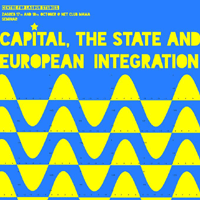 U sklopu programa posvećenog teoriji kapitalističke države, Centar za radničke studije poziva u net.culture club MaMa (17-18. listopada 2014.) na seminar tijekom kojeg će Jens Wissel, John Kannankulam, Werner Bonefeld i Bob Jessop adresirati fundamentalna pitanja o prirodi kapitalističke države, stupnju transfera njenih prerogativa na EU i transnacionalne institucije, “podjelu rada” između nacionalnih i transnacionalnih razina, klasni karakter ovih procesa, njihove implikacije po demokratske standarde, kao i moguće kontradikcije i perspektive za budućnost.
net.culture club MaMa, Preradovićeva 18, Zagreb, 17-18.10.2014.
Seminar:“Capital, the State and European Integration”
Until not too long ago, even amongst parts of the left, the historic decline of the relevance of the state was taken as a ‘given’. Under the umbrella of ‘globalization theory’ far-reaching proclamations on deep tectonic shifts were the height of fashion. At closer inspection, however, the impatiently sweeping character of many such generalizations more often than not revealed itself to be the consequence of a lack of both conceptual rigor and empirical scrupulousness, embarrassingly echoing much of the imaginary of neoliberalism’s triumphalism and its intellectual proponents.The onset of the financial and economic crisis of 2007/2008 and its consequences made many of these theoretical constructs seem obsolete over night. Large, coordinated state interventions and rescue packages were the order of the day, pointing to complexities in the relations between states and capital which simplistic end-of-state narratives seemed decisively badly equipped to tackle, let alone explain in any meaningful fashion. In some quarters this then lead to talk of a ‘return of Keynes’ or, more generally, proclamations of a ‘return of the state’ itself. But this pendulum swing in the opposite direction proved to be no less superficial and premature than what had preceded it. Rather than leading to a restoration of post-war Keynesianism, the dominant drive of crisis policies reaffirmed a preference for neoliberal solutions, now of an increasingly authoritarian character, devoid of old democratic niceties and former procedural inhibitions. Here too, a complex and often untransparent assemblage of markets, transnational institutions, nation states and their mutual interactions confirmed the deficiencies of much left thinking to adequately account for these processes and the shifting institutional architecture underpinning them.Yet without a proper understanding of the contemporary configuration of relations between capital, the state and transnational institutions, it will be impossible to judge the plausibility or implausibility of various competing proposals on the left and their respective strategic projections. Nowhere more so than within the European Union, where deepening integration now assumes the seemingly paradoxical form of deepening socio-economic fragmentation along national lines and a palpable regional polarization into core and periphery. Centripetal and centrifugal forces seem to overlap and intertwine in a complex process with as of yet unclear long-term consequences for the future of the European project itself. The increasingly authoritarian character of ‘crisis-resolution’ policies pose long-term dangers for the subaltern classes and endanger formal-democratic standards long considered an irreversible historical achievement. In parallel, a new surge of right-wing populism all over Europe seeks to take advantage of the ensuing socio-economic degradation and political disillusionment…In trying to address these complex issues, the seminar will revisit fundamental questions on the nature of the capitalist state, the degree of transfer of its prerogatives to EU and transnational institutions, the ensuing ‘division of labour’ between national and transnational levels, the class character of these processes, their implications for democratic standards, as well as their possible contradictions and future perspectives. The political stakes are clear: only by properly understanding the structural conditions of the current conjuncture, its institutional complexities, inherent limits and contradictions, can viable left strategies be formulated.
Programme
Petak, 17.10.2014.
- 11.00-12.30
- Jens Wissel: The EU as a New State Project
- John Kannankulam: Competing Hegemony Projects in the Current European Crisis: a Historical Materialist Policy Analysis on Political Struggles
- General discussion
Lecture
15.30-17.00
Lecture
17.30-19.30
Subota, 18.10.2014.
- 11.00-12.30
- Werner Bonefeld: European Economic Constitution and the Transformation of Democracy: On Class and the State of Money and Law
- Bob Jessop: States and State Power: A Strategic-Relational Approach
- General discussion
Lecture
15.30-17.00
Lecture
17.30-19.30
Abstracts:
Jens Wissel: The EU as a New State Project
Against the backdrop of a global trend towards neoliberal constitutionalism, the EC/EU became, from the mid-1980s, an important supporter of a Europeanised fraction of the capitalist class showing first signs of transnationalisation. This development was a result of the emergence of the competition state. It is also manifest in the formation of a European power bloc, for which European and transnational institutions are of increasing importance.
In contrast to mainstream state theory, materialist state theory does not perceive the state as a unified actor. Here, the state represents a material condensation of social relations of forces, which includes international constellations of forces. The individual apparatuses are linked, in a specific form, with the social relations of forces; as a result, the state has to be viewed as a complex ensemble of competing power and decision-making centres within and between state apparatuses. Accordingly, this ensemble consists of a “multiplicity of diversified micro-policies” (Poulantzas). The EU can be seen as a new state project, on whose terrain a new scalar structure and hierarchies between state apparatuses emerge. This concerns both the European and national state apparatuses. The relationships between and the positions of the various apparatus are fairly flexible; they result from a constant process of negotiating. Notwithstanding the dynamic of this new state project there is still no consensus on the hierarchy of scales in the EU. As a result, the EU and the national and European apparatuses are not only pervaded by social contradictions, but also, and to a stronger degree, by the competition between the different scales and different state projects. The emergence of a European border regime and the production, at a European level, of processes of inclusion and exclusion transform the EU into a territorial entity.
In this context a new control regime of global mobility evolves producing specific zones of stratified rights.
- Jens Wissel is a Fellow at the Institute for Social Research at the Johann Wolfgang Goethe University in Frankfurt, currently employed as a Research Associate at the University of Kassel.
* * *
John Kannankulam: Competing Hegemony Projects in the Current European Crisis: a Historical Materialist Policy Analysis on Political Struggles
In his paper John Kannankulam follows the question which specific relationship of forces – to follow the famous notion of the Marxist Greek-French state theorist Nicos Poulantzas – are to be identified within the recent authoritarian neoliberal European crisis programs like e.g. the Economic Governance and the Fiscal Treaty. Following an approach that has been developed out of an recently finished research project about the struggles around a common European migration policy (www.staatsprojekt-europa.eu), which following Ulrich Brand has been labeled as Historical Materialist Policy Analysis (HMPA), Kannankulam presents the concept of “Hegemony Projects” – which are analytically aggregated common strategies of different actors around a political conflict – as a mode to operationalize relationships of forces in the struggle around hegemony.
- John Kannankulam is an Assistant Professor for the Political Economy of European Integration at Marburg University, Germany.
* * *
Werner Bonefeld: European Economic Constitution and the Transformation of Democracy: On Class and the State of Money and Law
The contribution contends that the economic constitution of Europe amounts to a system of imposed liberty. It explores the roots of this construction in the neoliberal critique of unlimited mass democracy and introduces and assesses specifically the accounts of Friedrich von Hayek and Alfred Mueller-Armack on the market-facilitating benefits of European integration. In their view, European economic integration is beneficial because it restrains the democratic element of the liberal-democratic state, reinforcing the market facilitating purpose of the (neo-)liberal state. The paper holds that class is fundamental to the understanding of processes of European integration, and the institutions of monetary union in particular.
- Werner Bonefeld is a Professor of Politics at the University of York, UK.
* * *
Bob Jessop: States and State Power: A Strategic-Relational Approach
State theorists have usually attempted to theorize the state but this is a misleading focus that risks treating the state as a simple instrument or machine, a reified apparatus that is primarily a source of constraint on political action, or a more or less rational subject that exercises power. Such positions have been criticized from many alternative theoretical positions as well as proven unhelpful in empirical analyses. One important line of criticism, developed in a range of theoretical perspectives (e.g., Marx, Gramsci, Poulantzas, Foucault, Latour), is to refocus the analysis on the modalities of the exercise of state power considered as a complex social relation. I develop the implications of this strategic-relational perspective and consider its relevance to the transformation of state power in the present phase of imperialism.
- Bob Jessop is a Professor of Sociology at Lancaster University, UK.
Programme of Centre for labour studies is supported by Rosa Luxemburg Stiftung Southeast Europe.
14. listopada 2014.